
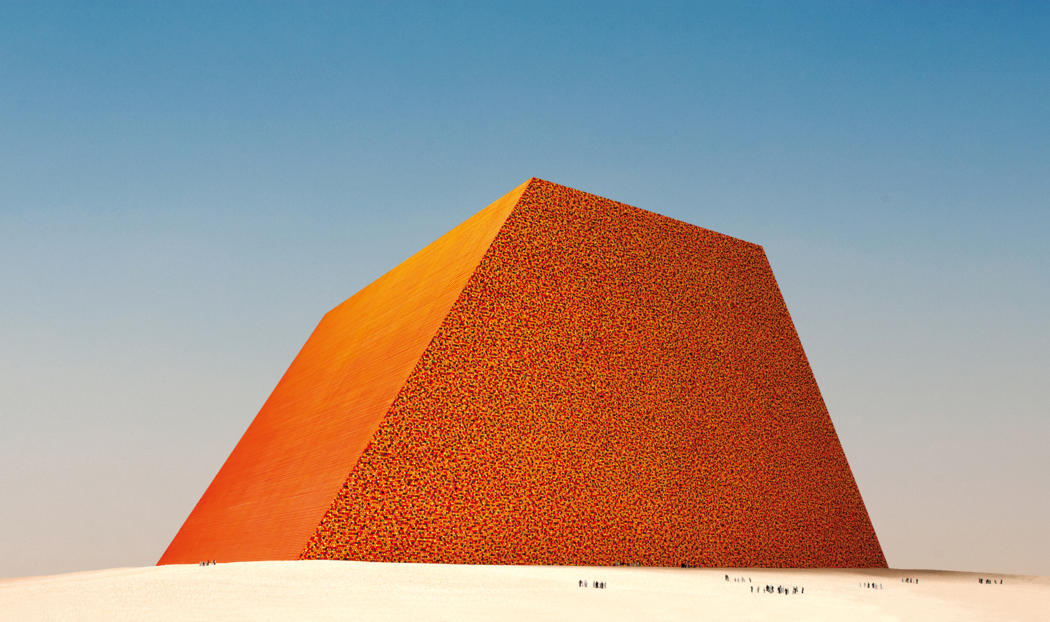
Christo The Mastaba of Abu Dhabi (Project for United Arab Emirates) Scale model 1979 32 1/2 x 96 x 96" (82.5 x 244 x 244 cm) Enamel paint, wood, paint, sand and cardboard Photo: Wolfgang Volz © 1979 Christo
Time to get angry about another gross display of wealth by the art world, all at the expense of the poor. According to The Guardian, Christo has plans to make the world’s largest sculpture from empty oil drums in Abu Dhabi, and now the project has the support of the Sheikh Hamdan bin Zayed al-Nahyan, a representative of the crown prince, his elder brother. A site near Liwa oasis has been approved.
The Mastaba will be made from nearly 410,000 oil barrels, and with estimated construction costs at $340m (£212m) it will be the most expensive artwork ever made. Aesthetically, the work perhaps has most in common with Michael Heizer’s City, a two kilometer long earth work that attempts to synthesize ancient monuments, Minimalism, and industrial technology. Here, the stacked barrels painted in colors inspired by the desert will resemble a jewel. “When the sun rises, the vertical wall will become almost full of gold,” Christo told The Observer.
I don’t love that so many resources are being dedicated to a sculpture when there an enormous number of people in Abu Dhabi are extremely poor, exploited workers. In 2009, Human Rights Watch released a report on Abu Dhabi’s treatment of migrant workers, documenting near slave labor conditions. Since then, Abu Dhabi has made significant reforms, but the conditions are still far from perfect. It’s worth noting that the Guggenheim, which is currently building a museum in the region, continues to be targeted for boycott by artists and prominent figures in the Middle Eastern art world, thanks to its use of migrant workers.
Christo, though, seems content to ignore all this. He says the oil barrels are not meant to be a comment on the UAE’s oil wealth, citing a work he made in Paris with the same material. Now, of course, that’s bullshit, and a quick look at his website demonstrates as much; he also has plans for a near identical Mastaba in Houston Texas, another oil rich region.
So why pretend the work doesn’t carry the meaning it was almost certainly meant to have? No one but Christo can answer that for sure, but it sure seems like a convenient way of avoiding the toll this project will take on people’s lives. Given the location and scope of this project, I’m not so sure its benefits will outweigh the costs.


{ 6 comments }
On the other hand, art is the only field where you can still dream off “gross display of wealth”, without having to explain your ethic, that is to say without lying grossly the way it’s done in any other business today. Will this last piece of pure freedom also be gone soon ?
i had commented a couple days ago but it disappeared-
the short version is that i like it, it is something. unlike most art under discussion, which is limited by expectations and presentation, in that it is obvious and variations on a theme (art) in a status quo setting (an art space). for the barrel piece, its monumentality (see how small the peeps are in the photo illustration) and uselessness and transparent engineering will necessarily evoke something in the viewer. don’t like over the river, though; enough people (who actually live there) don’t want it, it’s also in a place that is unsullied by commercialism and rich people. abu dhabi on the other hand-
Sorry about that. Every once and a while disqualified randomly deletes a comment and it’s really annoying.
In any event, I agree that the piece will likely be magnificent. It’s what the piece represents that I don’t like.
maybe it will be the “let them eat cake” statement that might help change the government in that country, otherwise wow a monument to global warming, ew
To an extent, I agree with the sentiment. However, I think we should also look at the fact that $340M moving from oil money to art and laborers is a win. The working conditions in the middle east are tragic, there is no doubt about that, but until things change not having any work doesn’t put food on the table for those laborers either. I would hope that Christo would have some kind of input on the working conditions as the contractor, but who knows… I would also hope that he is denying the political implications of the project until it is finished. The pyramids are visited everyday despite the entire races that were enslaved in order to build them as an expression of limitless power and immortality i.e. if Christo builds this, and the oil-shit hits the fan, the ruling class will have 18,040,000 lbs of sarcasm on their hands – and that’s another win.
I think Christo’s art is shit. I can’t understand all the hipe over it. I don’t get the meaning of it. I think so many current artists are just creating tricky novelties and putting them out as art. Putting alongside each other incongruent parts is not art. So Christo’s sheets over a coastline has great novelty appeal because how incongruous it is but it totally fails to be essentially art. It produces a shock and that is about it. And the way the world is swallowing this shit astounds me. What in the hell is wrong with people??
Comments on this entry are closed.