
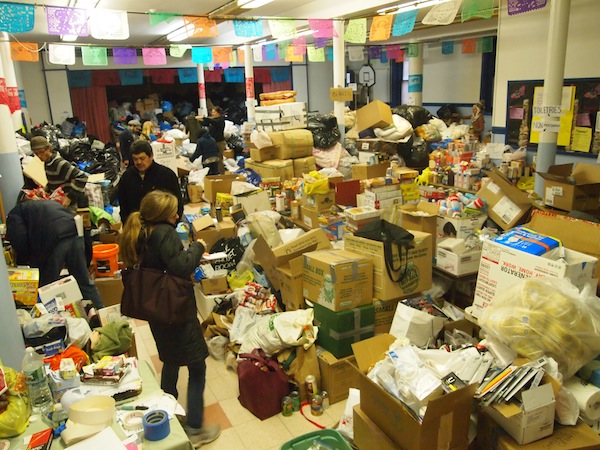
Occupy Sandy's centralized disaster relief system at St. Jacobi's Lutheran in Sunset Park. EDIT: An example of how social movements work better with individuals in designated roles (Image courtesy of Arun Venugopal, WNYC)
Merry Christmas, thinking, rational people. Evgeny Morozov has written the most satisfying takedown of quack internet moralizing to date.
In an excerpt from his upcoming book To Save Everything, Click Here: The Folly of Technological Solutionism, Morozov identifies what he calls “Internet centrism,” the blindly optimistic creed that the Internet has a logic of decentralization and crowd decision-making, which should be used to remodel real-world infrastructure. He rips what he deems the manifesto, Steven Johnson’s Future Perfect: The Case for Progress in a Networked Age, citing Johnson’s casual assertion that the NEA should be more like Kickstarter, and government be more like Wikipedia; i.e., that experts be dispensed altogether– something we heard often at Occupy, despite all the evidence to the contrary. To this, Morozov responds:
Better systems for aggregating and dispensing knowledge can certainly help to solve many problems, but those are problems of a very peculiar nature. Can Washington’s reluctance to intervene in Syria—to take just an extreme example—be blamed on a deficit of knowledge? Or does it stem, rather, from a deficit of will, or of principle?
And it gets better:
This lack of curiosity about how the world works is the most pernicious feature of Internet-centrism…[Johnson] never asks what it is that the NEA actually does, how it sets its agenda, and what it hopes to achieve.
Is the kind of expertise that the NEA relies on additive? Does the cumulative knowledge of ten mediocre wanna-be art critics on Kickstarter equal that of one art wonk who works at the NEA?
He’s got my money. You can read the full essay on New Republic and pre-order the book on Amazon for only $17.


{ 27 comments }
Excellent! I only wish Morozob had asked why Johnson didn’t fund his book through Kickstarter.
Good point! But blow for blow, the piece is suhhoooo satisfying. Definitely recommend people read the whole thing.
Totes.
Morozov makes some good points, pure techno-utopianism is highly questionable…. but so is your decision to lead off this AFC piece with a photo of donations collected by Occupy Sandy. My guess (and maybe I am totally off-base here) is that you were not personally at the mercy of FEMA in Far Rockaway (or anywhere else) in the immediate aftermath of the storm. I wasn’t either, but I had filled up my Subaru’s gas tank on Sunday. Dumbfounded by images and reports of the destruction, I spent the following weekend driving “official” (i.e. city council collected) donations down to the Rockaways. After being shooed away from our initial destination of a FEMA site, my girlfriend and I stumbled on to a DIY relief station being set up by Occupy Sandy. That they were filling a void AND doing real good is undeniable. It was real and tangible, and had nothing to do with “KONY 2012”-style feel-good clicking.
You’re totally off-base here. A previous version of this had a line about Occupy and how its greatest success (its efforts during Sandy) were the result of becoming a little less techno-utopian. Admittedly, the only evidence I can find of that anymore is the caption mentioning “centralized” compared to the maligned “logic of decentralization”. I definitely see how it could be confusing.
So, (and to be clear the “you” I addressed was Whitney Kimball, as per the byline….) am “totally off-base” b/c you (Will Brand) were IN FACT S.O.L. (i.e. hungry and in the cold, belongings at the curb, etc…). What is confusing is how ruffled the collective Fag Feathers become when people respond to pieces NOT attributed to your collective mind. AND if you weren’t indicted Occupy Sandy, no, that was completely unclear. “Previous versions” aside, all I see is a photo of OCCUPY SANDY followed by a ringing endorsement of a pretty harsh critique of the “OCCUPY mindset” as it were….
That’s absolutely not the intent with this image. Morozov’s arguing that internet-centrism fetishizes decentralization and horizontal power as something that’s inherently good about the internet and should be applied to social movements like Occupy. Not only are those not inherent qualities about the internet, but Occupy works best when it has a central point of organization (like the Occupy Sandy donation hubs) and people start making executive decisions. I understand how this image could be misconstrued because I didn’t include that portion of Morozov’s argument, so that’s my bad.
In fact, Occupy Sandy worked so well that I already assume that everyone sees this image as representative of success.
the collectively ruffled fag feathers are the biggest fault of this site. undeniably offputting. on a site with a great many strengths.
I’m not sure I understand the problem here. Will quoted David’s comment to offer a response that said he could see how there could be some confusion.
“(and maybe I am totally off-base here)”
You know what, if you read my comment, it’s pretty clear I’m conceding your point. I admit (“admittedly”) that it was confusing, I use exactly the phrase you offered (“off-base”), and I explained the flaw in our process that made that happen. I’m not really sure what you want here. We’ve already written thousands of words about how Occupy is amazing and good etc. and I’m not sure what more we need to do to prove that to you.
Does the fact that some of the Pirates wore shorts or that some in Occupy were working around the Occupy format or even that these types of groups are short lived mean that non-hierarchal political movements bring no value? for Morozov to intimate that–and he seems to–might be as totalizing as he claims Johnson et al to be.
I don’t think he’s saying their ideologies bring no value, I think he’s just saying that decentralization paralyzed a lot of their efforts.
BTW….I “assume” you’ve heard the old adage about what happens when one assumes….
there seems to be a pattern of you all rushing to the defense of the others. given all of you all’s smarts and skills, i don’t see why that needs to happen.
….err, yeah, but only after saying I was “totally off base here”. When I suggested I may be “off base” it was in reference to the presumption that only someone thoroughly removed from the situation would take shots at OCCUPY SANDY (flawed no doubt, BUT….). Sorry, no offense, but this is a sloppy post.
If I didn’t have a stake in what went up on this blog, I’d be a really shitty editor.
OK, so you edited the caption, but it still doesn’t add up (photo, caption, text). It just doesn’t. You guys should have chosen a better photo to start with. One that *actually* illustrated the point. This post is just a mess all around. Editorial fail. Whether that translates to you being a “really shitty editor”, well….go easy on yourself. IT’S JUST A BLOG….
Can we all relax about the photo choice and caption here. David, if you don’t like how the new caption reads, offer an alternative. We’re not changing the photo. You don’t have to like it, but it has meaning to all of us, and that’s a fair rationalization for any image choice.
The rest of this exchange needs to stop. You guys aren’t doing anything more than needling each other. It’s not at all productive.
but…but…nobody’s making fun of Occupy Sandy! Will was just explaining why this was a misleading image. And I take full credit for that.
OK….and that’s why I’m “totally off base”. I “totally” get it now. Credit where credit is due…..
I get it. You think the image is inappropriate, and you think the way your point was conceded was rude. I don’t think any of that was intended, but let’s not dwell on this. Your point has been made.
Anything to say about Morozov, or can we close this conversation?
You got it, Paddy. I’m pretty much bored now, anyway. BUT, while I have your ear…. I think the ARTFCITY rebrand is a real shame. It’s sad to see you start taking this art blog thing so seriously. “End of an era”, “as they say”….
Ha! I always took this blog that seriously!
Seriously, though, no one loves that we had to change the name, but you know, it’s not just about having your email filtered into spam each day. I’ve spent the last eight years living below the poverty line. After a while, you just want to be able to buy a hamburger and not stress out about it. The rebrand is simply meant to solve that problem; we don’t have any secret plans to also roll out a content farm.
To be clear, I was never interested in ART FAG CITY’s Occupy street cred or anything of the sort. Your concession or whatever was not at all clear. It starts off by (yes, quoting me….) stating that I am off-base. Do you know what that phrase means?
And as far as the “flaw in [your] process”….you mean poor editing?
Comments on this entry are closed.